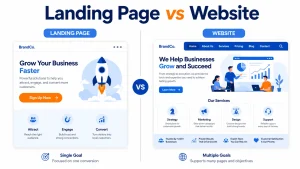
In today’s digital landscape, having an online presence is no longer optional, it’s essential. But having a website alone is not sufficient; you need to develop a strategy for the various aspects of your business, such as landing pages and websites.
While these may sound similar on the face of it, there is actually a vast difference between them, and understanding how to leverage both effectively can have a tremendous influence on your marketing outcomes.
In this article, we will learn about the difference between a landing page vs website, along with the significance of these aspects and how their combination can help boost your SEO efforts.
What is a website?
A website is a collection of related web pages that are connected and accessible through the internet using a single domain name. It can contain various types of content such as text, images, videos, and interactive features, all organized to provide information or services to users. Websites are stored on web servers and can be accessed through browsers like Google Chrome or Mozilla Firefox by entering a specific web address. Each website usually has a main page, known as the homepage, along with additional pages like about, contact, or blog sections. In today’s digital world, websites are used for many purposes, including business promotion, education, entertainment, and communication, making them an essential part of everyday online activity.
What are Landing Pages?
An independent website made especially for a marketing or advertising effort is called a landing page. After clicking on a link in an email, advertisements from Google, Bing, social media sites, or other comparable websites, a visitor “lands” there. A call to action (CTA) is the main focus or objective of landing pages, unlike normal webpages.
Because of this emphasis, landing pages are ideal for promoting particular business or marketing goals, such as email subscriptions, event registrations, or product sales. By removing distractions and directing users toward your conversion objective, you can elicit a single desired action from visitors.
The Core Differences between a Landing Page vs Website:
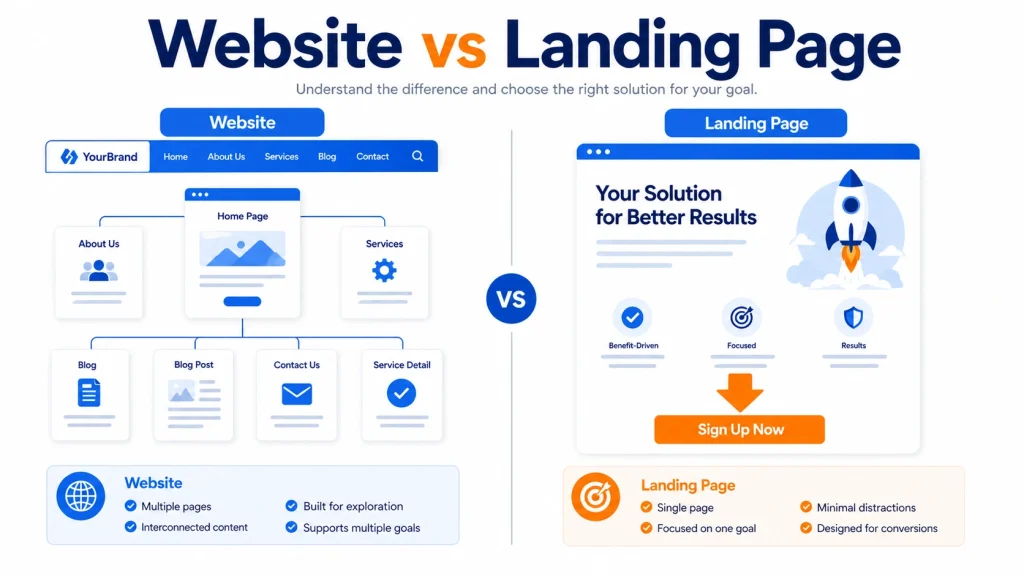
The key difference between a landing page vs a website is based on their goal. Landing pages are aimed at achieving specific outcomes instantly. They are direct, straightforward, and geared toward taking some actions. Websites, in turn, allow their visitors to explore the information offered and make decisions after a detailed study of all aspects and opportunities.
To put it simply, landing pages are action-oriented, whereas websites are exploratory.
The Key Differences Between the User Experience
Another significant difference is related to how people interact with each format. A user visiting a landing page will follow its preset structure, starting from the top and going down to the call-to-action section at the bottom of the page. No extra links to other destinations will distract visitors from achieving the required goals.
People using a website can follow several different paths through it. Visitors are free to go wherever they want, and such liberty allows for building additional trust.
Marketing and Traffic Strategy
It is also important to mention the different marketing and traffic strategies used by landing pages and websites. The first format is usually associated with marketing
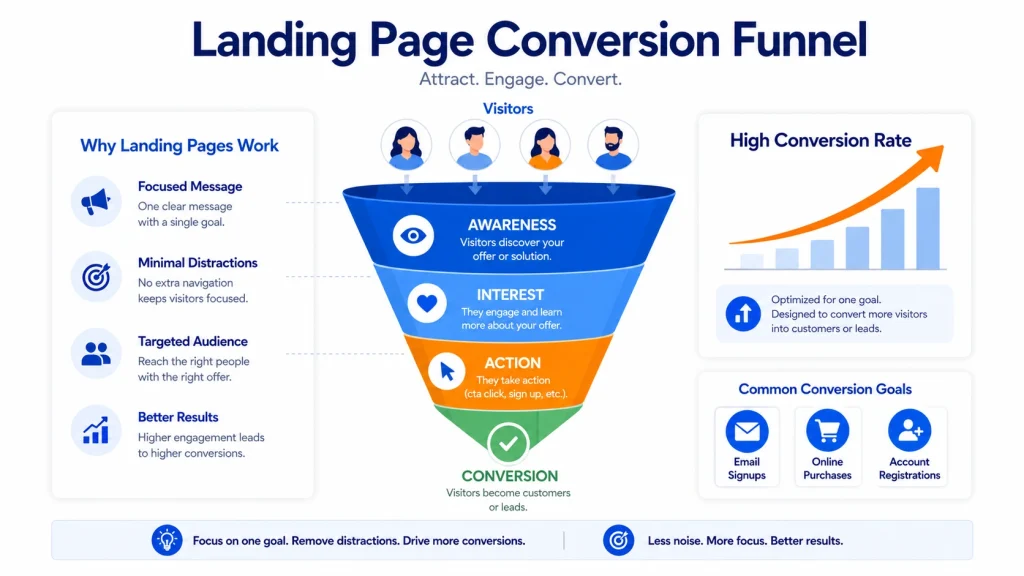
Why Landing Pages Have Higher Conversion Rates
The landing page’s concentrated nature makes it more efficient at converting visitors. It offers only one choice to the visitor, and everything in the design revolves around it. While the website may take time to convert, it still plays an important role in decision-making.
An initial visit to a website may not result in purchasing a product, but the information available will build confidence and encourage repeat visits.
Using Landing Pages and Websites Together
What works best is neither picking one over the other nor sticking only to one strategy. A website represents the base on which you can build further campaigns, while landing pages are designed specifically to be used in such campaigns.
Thus, one can use ads to drive traffic to the landing page to get immediate results. Then, those people may proceed to the actual website to find out more information.
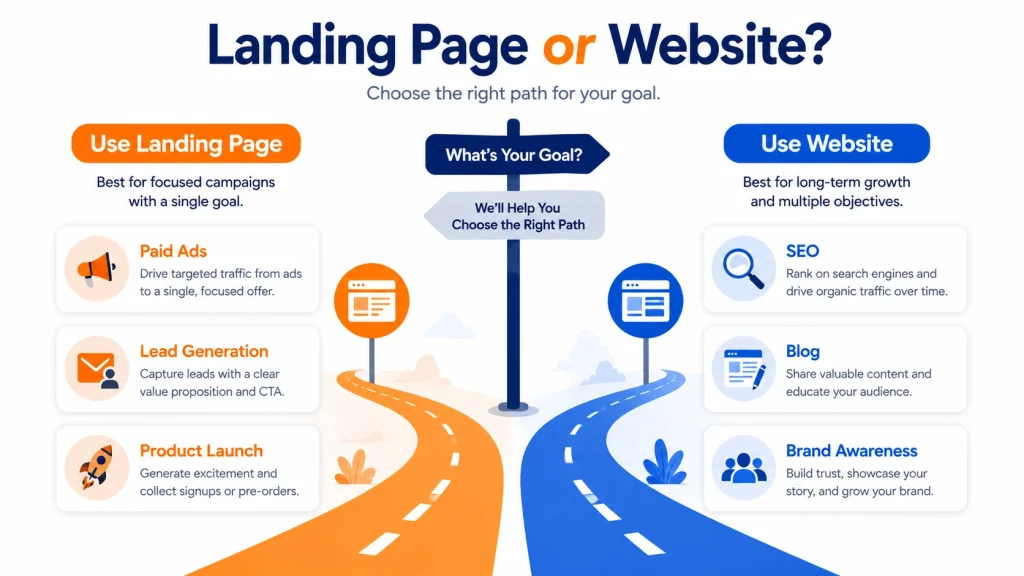
When to use a landing page vs a website
When your goal is simple and fixed, then you can use a landing page to get the best result.
Use a landing page when:
- Paid Ads: When you start a paid campaign, the landing page is best for a good outcome.
- Lead generation: To generate leads, such as email addresses and phone numbers, a landing page works well.
- Product Launch: When launching a new product or offer, a landing page keeps the focus on one goal.
- Promotions & Offers: For discounts or limited-time deals, landing pages drive quick action.
- Single Goal Campaign: If your goal is one specific action, a landing page is the right choice.
Use a website when:
- Brand Awareness: When you want to build trust and show your business, a website is better.
- Multiple Services: If you offer different services or products, a website helps users explore everything.
- SEO & Organic Traffic: To get traffic from search engines, a website is essential.
- Content Marketing: For blogs, articles, and long-term content, a website works best.
- Long-Term Growth: If your focus is on building a strong online presence use a website.
Conclusion
The debate between landing page vs website is not about which one is better, but it’s about how they work together.
The landing page and website are not enemies, but friends. They are different, but they play equally important roles in creating a strong online presence.
Landing pages are designed for prompt action with one message in mind, while websites aim to deliver depth and credibility while maintaining connections. You can achieve better results by knowing what these two are used for and which is best suited for your needs. The key to success is choosing the right tool.
Landing Page vs Website – Comparison Chart
| Feature | Landing Page | Website |
| Primary Goal | Focused on a single action | Provides complete information and brand presence |
| Structure | One standalone page | Multiple interconnected pages |
| Navigation | Minimal or no navigation | Full navigation menu (Home, About, Blog, etc.) |
| User Intent | Action-oriented (signup, buy, register) | Exploration and research |
| Content Focus | Highly targeted and specific | Broad and detailed |
| Call-to-Action (CTA) | One strong, clear CTA | Multiple CTAs across pages |
| Conversion Rate | Typically high due to focus | Lower, but builds trust over time |
| Traffic Sources | Paid ads, email campaigns, social media | Organic search (SEO), direct traffic |
| SEO Role | Limited SEO value | Strong for long-term SEO growth |
| Use Case | Campaigns, promotions, lead generation | Branding, information, long-term engagement |
What is the main difference between a landing page and a website?
A landing page is a single, focused page designed for a specific goal, such as lead generation or sales. A website has multiple pages covering all aspects of a business. Landing pages drive quick action, while websites build long-term trust and brand presence.
Can a landing page act as a website?
A landing page can work temporarily for very small businesses, but it cannot fully replace a website. A website offers better SEO, multiple pages, and comprehensive brand information that a landing page cannot provide.
Why do landing pages have higher conversion rates than websites?
Landing pages focus on a single goal and remove distractions such as navigation menus and extra links. Every element guides the visitor toward a specific action, making it much easier to convert than on a full website.
When should I use a landing page instead of a website?
Use a landing page for paid ad campaigns, new product launches, lead generation, or limited-time offers. It keeps visitors focused and drives faster results for specific marketing goals.
Can I use both a landing page and a website together?
Yes, and this is the smartest strategy. Run paid ads to your landing page for quick conversions, and let visitors explore your full website to build trust and learn more about your business.
How do landing pages and websites work together in digital marketing?
Websites act as your brand’s central hub for SEO and information. Landing pages handle specific campaigns for quick results. Together, they effectively cover both long-term growth and short-term conversion goals.
Is it better to have a landing page or a website?
It depends on your goal. For quick campaign results, a landing page is better. For long-term SEO and brand building, a website is better. Ideally, every business should have both for maximum digital marketing success.
Is a landing page just a one-page website?
No, they are different. A one-page website covers multiple topics, such as About, Services, and Contact. A landing page focuses on a single goal and a single CTA. It is built specifically for marketing campaigns, not for general brand information.